
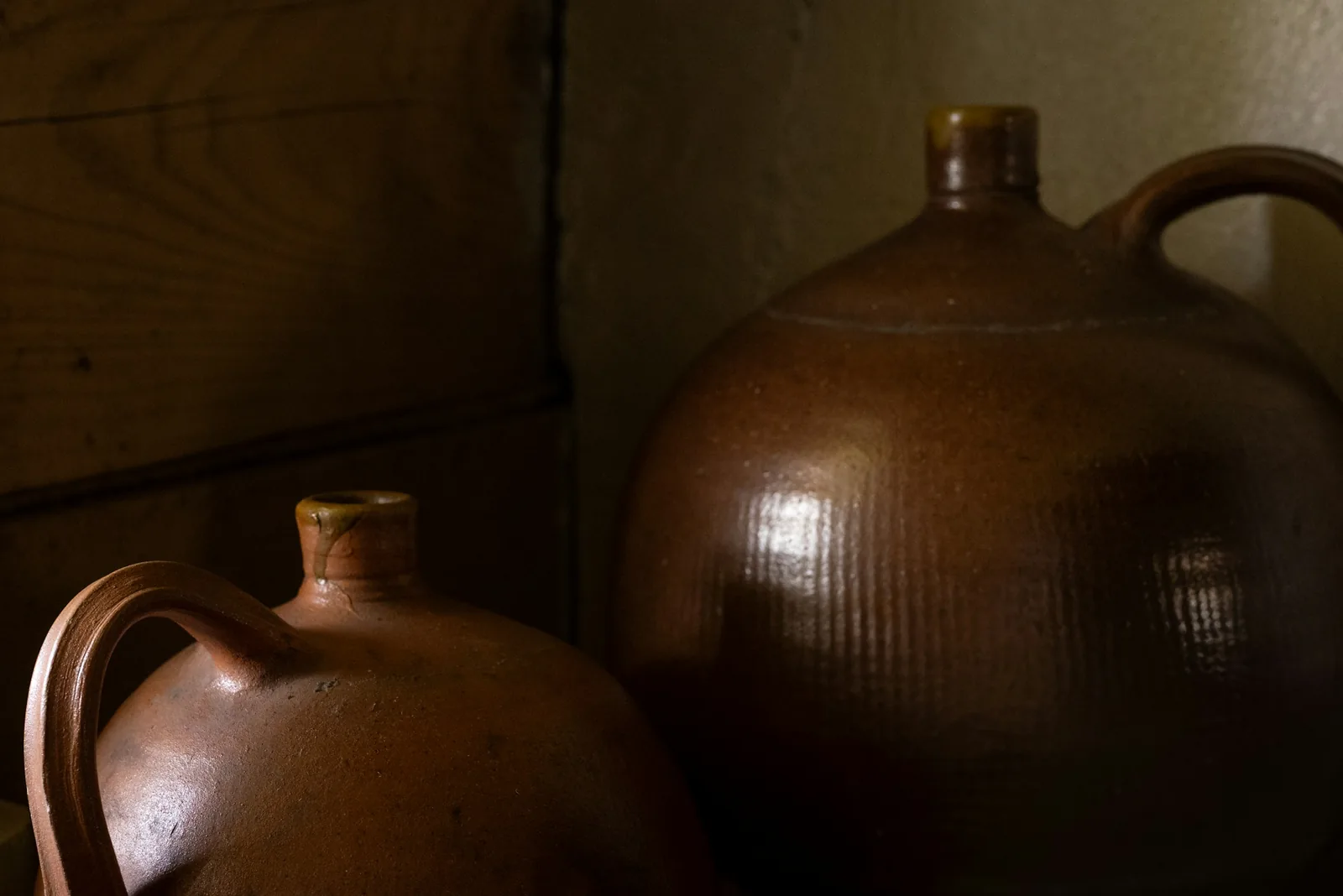
Most antique crocks are plain utility stoneware, and some decorated pieces in southern Wisconsin homes are modern stoneware, made in Cambridge since the 1970s by makers like Rowe Pottery and Rockdale Union Stoneware. Turn each piece over first: the mark, any date stamp and the wear tell you what you have. Then leave it as it is.
Old stoneware jars were working tools. Families packed butter, pickles, kraut and salted meat in them, and farms used them by the dozen. That's why so many survive, and why most are common. What draws interest is specific: a maker's mark, a strong decoration, an unusual size or form, and condition that hasn't been scrubbed, patched or bleached.
Southern Wisconsin adds a twist. Cambridge, a neighbor of Deerfield, has been home to potters making salt-glazed stoneware in the old style since the 1970s, and their pieces now turn up in estates alongside 19th-century stoneware. Telling the two apart starts with the bottom of the piece, not the blue on the front. Families clearing a house can start with our list of what not to throw away; old stoneware is on it.
What are antique crocks?
An antique crock is a stoneware storage jar, usually straight-sided with a wide mouth, made to hold food or liquid before refrigeration. Most are gray, tan or brown, glazed inside and out, and many carry a number showing their size in gallons.
Wisconsin made its own. In a 2000 talk summarized by the Wisconsin Pottery Association, Mark Knipping of the State Historical Society of Wisconsin explained that the state's earliest pots were red earthenware, glazed on the inside so they would hold liquid, while stoneware was fired much hotter and came later. Wisconsin stoneware dates to the 1840s, with its heyday from 1848 to 1875, from makers such as John B. Maxfield of Milwaukee and a pottery in Whitewater. Stoneware of every age turns up in our past catalogs, from unmarked utility jars to dated Cambridge pieces.
Red Wing crocks: the name collectors know
Ask about old stoneware in Wisconsin and someone will mention Red Wing, across the river in Minnesota. According to the Minnesota Historical Society's MNopedia, the Red Wing Stoneware Company formed in 1877 to mass-produce crocks, jugs, churns and jars for farm use. In 1906 the remaining firms merged as the Red Wing Union Stoneware Company and shipped across the country; the company became Red Wing Potteries after 1936 and closed for good in 1967.
Because Red Wing shipped so widely, the Wisconsin Pottery Association notes it has a very large collecting market nationwide. If you're wondering about Red Wing crock value, the questions are the same as for any stoneware: what exactly the mark says and where it sits, the size, the decoration, and the condition. Write all four down before you talk to us about selling.
Wisconsin pottery from Cambridge: Rowe and Rockdale Union
Rowe Pottery's own company history says it was founded by Jim Rowe in Cambridge as a small studio dedicated to traditional salt-glazed stoneware, in the period it lists as 1975 to the 1980s, and that it marked 50 years in 2025. It still works from Cambridge as of November 2026. Rowe pieces in our own catalogs have carried an impressed stamp with the maker, the town and a year.
Rockdale Union Stoneware is the other Cambridge name you'll see. The Wisconsin Pottery Association lists it as originally from Cambridge and making stoneware from 1983 to 1997, with a move to the Edgerton Industrial Park around 1990. Both makers are among the Wisconsin pottery in our past catalogs. Pieces like Lot 186, a 1989 Rockdale Union pitcher, are wonderful in their own right; they simply aren't 19th-century pieces, and a buyer will read the stamp before the decoration.
Read the base before the blue
Here's the habit we'd suggest for any stoneware, and it's our editorial judgment rather than a published method. The cobalt flower or bird on the front is what catches your eye, so check it last. Pick the piece up with both hands, turn it over, and work from the bottom up:
- Look for a stamp on the base or low on the side: a maker, a town, a year, a wing, a size number.
- Write down every word and number exactly as it appears, including pencil marks or old store numbers.
- Note the form: crock, jug, churn, pitcher or bowl, and its height.
- Note the condition: chips, cracks, hairlines, stains, a missing lid.
- Then look at the decoration, and photograph the front, the back and the mark.
| What you find | What it suggests | Before you assume |
|---|---|---|
| Maker, town and year stamped in the clay | A dated piece, often a modern one in the old style | Don't judge age by the decoration |
| A wing or Red Wing name | A Red Wing piece from Minnesota | Record the exact wording and where it sits |
| Only a size number | A utility crock with no maker named | Form and condition carry more weight |
| No mark at all | Could be old or new | Note glaze, wear and size; don't guess |
| Handwritten numbers on the bottom | A store, family or inventory mark | Leave it; it's part of the record |
Our editorial guide, not a measurement. One clue rarely settles a crock's age or maker.
Condition: leave old crocks exactly as they are
Stains, rings and old residue inside a storage jar are part of its working life, and they tell a buyer the piece is what it seems. Leave it as it is until Marv has looked at it: no bleach, no scrubbing, no glue on a chip, no paint over a crack. Note damage plainly instead. An honest "hairline crack on the back" builds more trust than a fresh repair.
Stoneware is heavy and brittle at the rim. Carry each piece from underneath with both hands, never by a rim or handle, and don't stack them. If a move or a downsizing is driving the sale, our downsizing tips for seniors cover the logistics.
Selling antique crocks near Madison
We run estate, household, antique and farm auctions from downtown Deerfield, about 15 minutes east of Madison, and all bidding happens online through HiBid, so collectors well beyond Dane County can see every crock, jug and pitcher. Every lot is numbered, described and photographed, and single pieces and single collections are consigned into our sales regularly.
Stoneware rarely travels alone. Stoneware steins and tavern pieces have their own guide in breweriana, and the dishes in the same cupboard are covered in what to do with old china. One request before any of it moves: don't throw anything away until we've looked at it. The piece a family is sure nobody wants is often the one that draws the most attention.
Common questions
How do I know if my crock is antique?
Turn it over first. A stamp with a maker, a town and a year can settle it quickly, and some decorated pieces turn out to be from the 1980s or 2000s. With no mark, note the form, glaze, wear and size, photograph everything, and let someone who handles stoneware look at it before you decide anything.
Are Red Wing crocks worth anything?
Some draw strong interest, because Red Wing shipped stoneware nationwide and has a large collecting market. What decides it is the exact mark, the size, the decoration and the condition, including chips and cracks. Write those down, leave the crock as it is, and bring the details to a free consultation rather than relying on a price list.
What is Rockdale Union Stoneware?
Rockdale Union Stoneware was a Wisconsin maker that, according to the Wisconsin Pottery Association, came from Cambridge and made stoneware from 1983 to 1997, moving to the Edgerton Industrial Park around 1990. Its pieces echo older stoneware, and the 1989 pitcher in our August 2026 sale carries a dated mark, so read the mark before assuming age.
Is Rowe Pottery antique?
No. Rowe Pottery's own history says it was founded by Jim Rowe in Cambridge, Wisconsin, as a studio making traditional salt-glazed stoneware, starting in the period it lists as 1975 to the 1980s. Many pieces are stamped with the year they were made. They're Wisconsin pottery with a following, but not 19th-century crocks.
Should I clean an old crock before selling it?
No. Leave stains, rings and residue exactly as they are until someone who knows has seen the crock. Bleach and scrubbing can change the surface buyers judge, and nothing puts it back. Don't glue chips or fill cracks either. Describe the condition plainly, photograph the mark, and keep any lid with the crock.
Does a crack ruin an antique crock?
It changes how buyers see the piece, but it doesn't make it unsellable. Buyers weigh the maker, the decoration and the size alongside the damage. What hurts more is a hidden or fresh repair. Note every chip and hairline plainly, leave it unrepaired, and let the next owner decide whether to fix anything.
Where can I sell antique crocks near Madison?
Dorshorst Auctions works out of downtown Deerfield, about 15 minutes east of Madison, and Rowe Pottery and Rockdale Union stoneware appear in our past catalogs. All bidding is online through HiBid. Call Marv at (608) 628-1631 for a free consultation, and leave every crock where it is until he has seen it.
Sources
- Early Wisconsin Stoneware & Earthenware, Wisconsin Pottery Association
- Red Wing Pottery, MNopedia, Minnesota Historical Society
- Company History: 50 Years of Rowe Pottery, Rowe Pottery
- 2008 Show: Pauline & the Pottery of Edgerton, Wisconsin, Wisconsin Pottery Association