
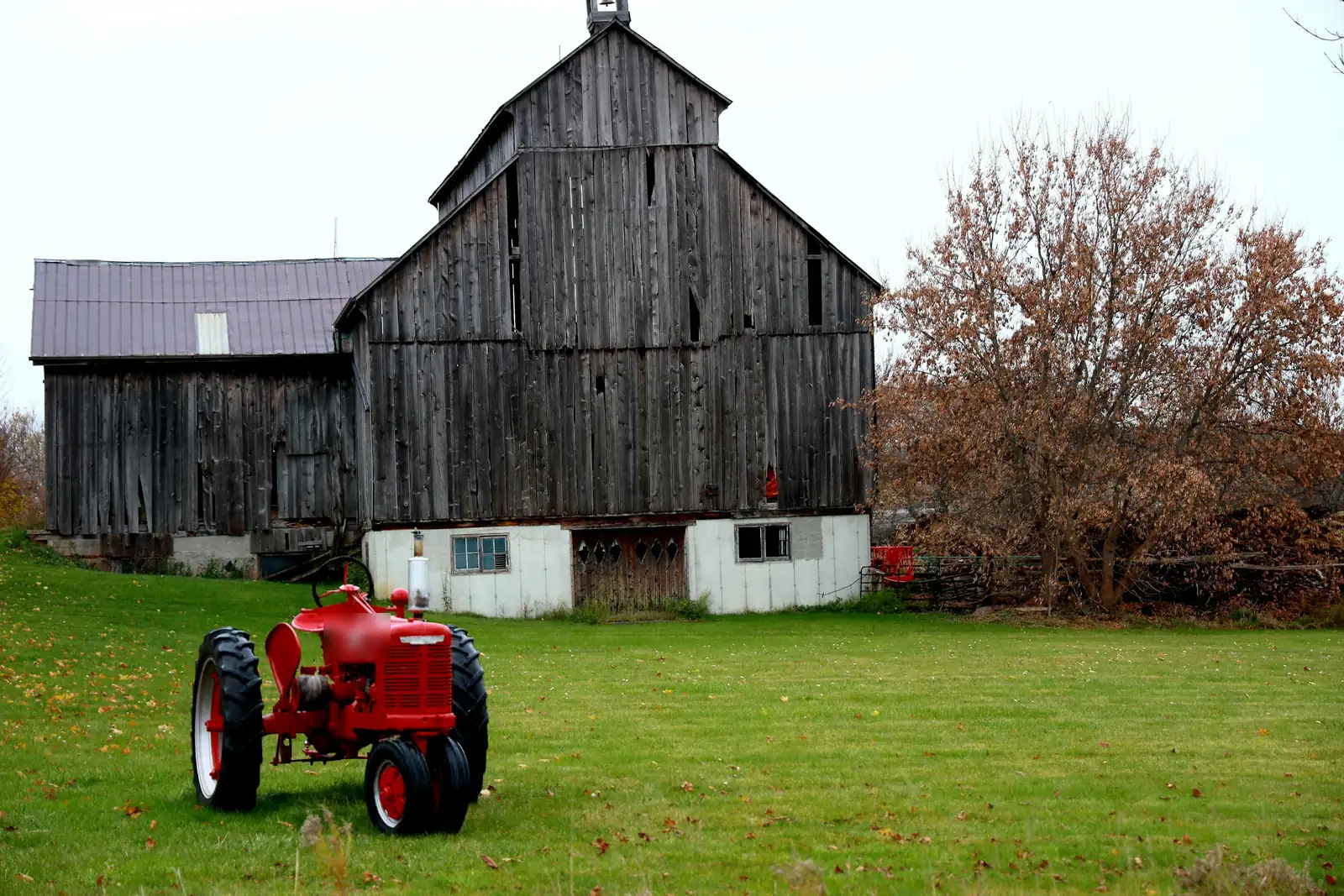
A farm retirement auction sells a farm's machinery, shop tools and often the household when a farmer steps back. Plan it as three sales in one, the field, the shed and the farmhouse; settle succession, titles and liens, and see a tax professional, before the sale; and leave everything as it is until it has been looked at.
For many Wisconsin farm families, the words farm auction bring up one scene: a crowd in the yard, machinery lined up off to the side, an auctioneer standing above the crowd. Wisconsin artist Lavern Kammerude pictured exactly that in The Farm Auction, and a signed, numbered print of it was in our August 2026 sale.
The reasons for a sale haven't changed much since: a farmer retires, no one in the family is taking over the machinery, or the land is being rented out. What has changed is how the selling works. This guide covers what to settle before a farm retirement auction, how to sort what's there, and where an online sale fits.
What a farm retirement auction is
A farm retirement auction sells the equipment, tools and often the household goods of a farm whose owner is stepping back, usually in one sale, so the family settles everything on one schedule instead of selling a piece at a time.
Our sales look different from the print. All bidding runs online through HiBid, so no one stands in the yard to bid, and the goods sit either at our Deerfield auction building or at the property itself when it's too large or too fragile to move. Our farm auctions have specialized in farm household items and tools; whether large field machinery, titled trucks or trailers fit one of our sales is a question for the consultation, not something to assume. Our past-sales list includes an Online Farm Auction dated April 24 to May 1, 2023, listed at 500 lots, and an online Family Farmstead sale listed at 588 lots. You can see Lot 324's catalog page from the August sale, and how selling with us works.
The need isn't going away. The USDA's 2022 Census of Agriculture profile for Wisconsin, the most recent census, counted 58,521 farms, 10 percent fewer than in 2017, and 36,307 of the state's 105,920 producers were 65 or older.
Before the sale: succession, liens and the land
UW-Madison Extension defines farm succession as the process of planning who will manage and own the farm in the future, and it offers a workbook and workshops, including one on organizing a farm's documents and financial information before estate planning. Settle that question before you set a sale date. A son-in-law who wants the planter, or a neighbor renting the ground who needs the drill, changes what goes on the sale bill.
- Liens. If a lender holds equipment as collateral, talk to the lender before anything is listed.
- Titles. Trucks, trailers and some other titled equipment need their titles found, whoever ends up selling or keeping them.
- The land. Whether the ground is sold, rented or passed on is a separate conversation with your attorney; this guide covers what sits on it.
- Family. Give each family member a written list and a reply-by date for the things they'd like, before the catalog is built.
If the sale follows a death rather than a retirement, authority comes first; our guides to transfer by affidavit and Wisconsin probate explain who can sign.
Field, shed and farmhouse: three sales in one
Here's the framework we'd suggest, and it's our editorial judgment, not a rule: treat a farm retirement auction as three sales in one. The field, the shed and the farmhouse each come with their own paperwork, their own buyers and their own questions.
| Pile | What's in it | Paperwork to find | Ask at the consultation |
|---|---|---|---|
| Field | Tractors, tillage and planting equipment, wagons, trucks and trailers | Titles, lien releases, manuals, service records | Whether large machinery, titled trucks and trailers fit one of our sales at all |
| Shed | Shop tools, welders, hand tools, fencing supplies, barn and dairy equipment | Manuals and any purchase records | Which lots ship and which are pickup only |
| Farmhouse | Furniture, crocks, prints, farm toys, kitchen and household goods | The family's list of what they're keeping | Timing around the move, and what happens to anything left over |
Our editorial guide, not a measurement or a legal requirement.
Sorting this way does two things. It shows which pile is really driving the timeline, usually the field, and it keeps the farmhouse from being an afterthought. The house and shed are often where the categories with real followings turn up.
How to sell farm equipment at auction, step by step
- Decide what stays. Anything promised to a successor, a family member or a renter comes off the list first.
- Gather the paper. Titles, keys, manuals and service records go in one box, and lien questions go to the lender.
- Leave it as it is. Don't wash, repair, repaint or haul anything before Marv has seen it.
- Walk through it together. The consultation covers which of it fits one of our sales (ask directly about large machinery, titled trucks and trailers), whether the sale runs from the farm or from Deerfield, and the calendar.
- Catalog. Every lot is numbered, described and photographed.
- Bid online. Bidding runs on HiBid for roughly a week and ends on a soft close.
- Pickup. Buyers collect in a posted pickup window; larger lots are pickup only, and small lots can ship.
- Settle. You get a clear accounting of what sold and for how much, which your tax preparer will want.
We run about seven or eight sales a year, so call well ahead of the date you have in mind. Previews are by appointment: call Marv. Our guide to 1/64 farm toys shows the collector side of the same farm interest.
Taxes on selling farm machinery
Selling equipment you've depreciated isn't like selling a used couch. The IRS Farmer's Tax Guide, Publication 225, says gains and losses from property used in farming are reported on Form 4797, and that a gain on machinery and other section 1245 property is treated as ordinary income to the extent of the depreciation allowed or allowable. It also tells farmers to keep records of when and how each asset was acquired, its full cost, improvements and the depreciation taken. Bring those records, and the sale's accounting, to your tax professional; if the farm is passing through an estate, our guide to Wisconsin inheritance tax covers the federal estate tax side.
The farmhouse: crocks, prints and farm toys
The farmhouse often holds the things families are most likely to underestimate: stoneware crocks, signed Wisconsin prints, pedal tractors, farm toys still in their boxes and shop tools from the basement. Those are categories that show up in our catalogs again and again. If there's a shelf of John Deere toys or a crock on the porch, read our guides to John Deere collectibles and antique crocks before anything is boxed up.

One request applies here as much as in the machine shed: don't throw anything away until we've looked at it, because the things people assume are junk are often the ones that draw the most attention. Let the family choose first, with a written record, and then sell the rest together.
When to talk to your attorney, tax professional or lender
This is general information, not legal or tax advice. Before the sale, talk to the right professional when:
- A child, relative or renter may take over part of the operation (attorney, and UW-Madison Extension's succession resources).
- Any equipment is pledged as collateral or has a lien (lender).
- You've taken depreciation or section 179 deductions on what you're selling (tax professional).
- The farm is held in a partnership, an LLC or a trust (attorney and tax professional).
- The land is being sold or rented at the same time (attorney).
- The farm is part of an estate: talk to the estate's attorney or personal representative before anything is listed.
When those answers are in, tell us what's on the farm and we'll talk through the sale.
Common questions
How do I sell my farm equipment when I retire?
Decide first what stays with a successor or renter, then gather titles, keys, manuals and service records and clear any liens with your lender. Leave the equipment as it is, and have an auctioneer walk through it. An auction sells the field, the shed and the house on one schedule instead of one buyer at a time.
Is a farm auction still held in the yard?
Not ours. Our sales run online: all bidding happens through HiBid over roughly a week, and the goods sit at our Deerfield building or at the property when they're too large or too fragile to move. Previews are by appointment, and buyers collect during a posted pickup window.
Do I pay tax when I sell farm machinery at auction?
Often, yes. The IRS Farmer's Tax Guide says gains and losses on property used in farming go on Form 4797, and gain on depreciated machinery is treated as ordinary income up to the depreciation allowed or allowable. Keep purchase and depreciation records, and talk to a tax professional before the sale.
What should I do before a farm retirement auction?
Settle succession, so you know what stays on the farm. Find titles and paperwork, ask your lender about liens, and give family members a written list with a reply-by date. Don't clean, repair or throw anything away until it's been looked at. Then call early, since we run about seven or eight sales a year.
Can household items and farm toys go in the same farm sale?
They can. Farm toys, crocks, signed Wisconsin prints and shop tools are categories that turn up in our catalogs again and again, and a farm sale often includes the house. Ask about it at your free consultation, along with how anything left over after the sale will be handled.
How many Wisconsin farmers are 65 or older?
The USDA's 2022 Census of Agriculture, the most recent, counted 36,307 Wisconsin producers aged 65 or older, out of 105,920 producers in all. The same census counted 58,521 farms in the state, down 10 percent from 2017. Many of those families will face succession and sale decisions in the coming years.
Sources
- 2022 Census of Agriculture State Profile: Wisconsin, USDA National Agricultural Statistics Service
- Farm Succession and Estate Planning, University of Wisconsin-Madison Division of Extension
- Publication 225, Farmer's Tax Guide, Internal Revenue Service