John Deere collectibles run from licensed toys to dealer signs, manuals and parts books. Interest depends less on the logo than on what the piece is, why it was made, its condition and whether its box or paperwork survived. Keep everything together, leave it as it is, and let someone look before anything goes.
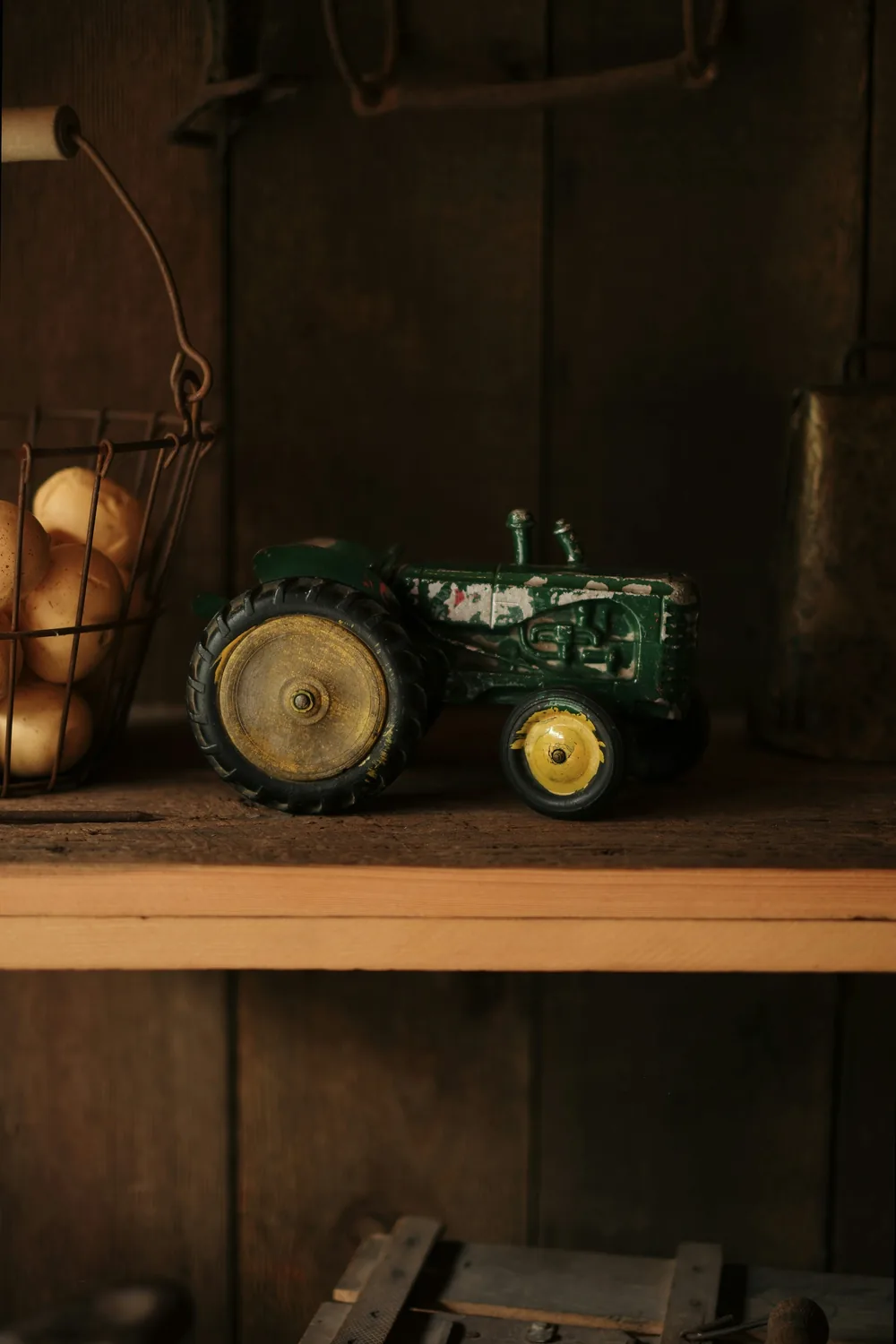
On a Wisconsin farm, the green machines often came in two sizes: the tractors in the shed and the small ones on a shelf in the house. Add a sign from the old dealership, a drawer of owner's manuals and a pedal tractor in the haymow, and a farm estate can hold a whole collection without anyone ever calling it one.
This guide is about the brand side of that collection. For what 1/64 scale means and how Ertl fits in, see our guide to 1/64 farm toys; for steel construction toys, see vintage Tonka trucks. Dorshorst Auctions is not affiliated with Deere & Company; we use the name because it is on the things families bring us.
A name that goes back to 1837
The John Deere name is older than most of the farms it is found on. A landmark plaque at John Deere's blacksmith shop in Grand Detour, Illinois, dedicated in 1976 by the American Society of Agricultural Engineers, reads: "On this site in 1837 John Deere built the first successful self-scouring steel plow, thereby making a significant contribution to the development of American agriculture." The ASABE historic landmark record carries the same text.
That long history is why the name shows up on so many kinds of things, made for very different reasons. Sorting them by that reason is the most useful first step, and you can do it without moving anything. If the collectibles are part of a larger farm sale, start with the free consultation.
The Made-For Test: field, dealership or shelf
Ask one question of each piece: what was it made for? This is our editorial guide, not a measurement, but it tells you who the next owner is likely to be and what belongs with each piece.
| Made for | Examples | Who tends to look for it | Keep with it |
|---|---|---|---|
| The field | Owner's manuals, parts books, tools and parts stamped with the name | People running or restoring old machines | The machine it came with, if there is one |
| The dealership | Signs, literature, display pieces | Collectors of farm and advertising history | Any hardware, frames or paperwork |
| The shelf | Licensed toys, pedal tractors, special editions | Toy collectors, often farm families themselves | Boxes, packages, cards and inserts |
Our editorial guide, not a measurement. Some pieces fit two rows; that's fine.
Whatever the row, the rules at home are the same. Don't throw anything away until Marv has looked, paper included. Don't clean, repaint or repair anything; leave it exactly as it is until Marv has seen it. And keep groups together: a manual with its tractor, a toy with its box, a sign with its hardware. Our guide to estate cleanout covers the paper side in more detail.
Made for the field
These are working items: an operator's manual for a specific model, a parts book, a wrench or an implement part stamped with the name. Their next owner is often someone keeping the same model running. That is why a manual should stay with the tractor it matches, and why a box of parts shouldn't be scrapped before someone has looked.
Made for the dealership
Signs, brochures and display pieces were made to sell machines, not to be collected. Today they interest people who collect farm and advertising history. Leave a sign's frame, brackets and any hardware with it.
Made for the shelf
Toys and pedal tractors were made to be played with or displayed, and many licensed toys were made to be collected from the start. For these, the box, the package and any card or insert are part of the piece.
John Deere toys: what decides interest
Most of the green toys families find were licensed and built by toy companies. The National Farm Toy Museum describes Dyersville, Iowa, as home to the Ertl Company, now TOMY, and Ertl is the name on the bottom of many of them. Licensed toys are still sold new today, so an old-looking box is not proof of age.
We don't put a value on toys, and there is no single answer to what John Deere toys are worth. In our editorial judgment, bidders weigh these things, roughly in this order:
- What it is: the model and the scale, both usually printed on the box.
- The edition: whether the box or card marks it as a special or collector edition.
- The box: sealed, opened, or gone; our 1/64 guide calls this the Box Ladder.
- Condition and completeness: paint, decals, wheels, and every hitch and implement.
- The group: a matched set or a whole farm kept together reads differently from one loose tractor.
Larger toys follow the same logic. Pedal tractors are one of the farm toy categories in our past catalogs, and in our editorial judgment, original parts and an honest description serve them better than fresh paint. To see how we describe a toy, look at lot 289, a 1/64 John Deere 4710 sprayer from our August 2026 sale.
Signs, literature and manuals
Dealer signs and printed pieces belong to the dealership row of the test. Reproductions of old signs exist, so don't try to settle whether yours is original by scrubbing, sanding or looking up a stranger's photo online. Leave it as it is and let Marv look; our guide to vintage gas station signs explains how to spot a reproduction.
Owner's manuals, operator's books and parts catalogs are easy to toss with the rest of the paper. Hold on to them. A manual that matches a machine in the shed belongs with that machine, and how the rest are grouped is easy to settle at the consultation.
Selling John Deere collectibles from a farm estate
Families settling a farm are often handling machinery, a house and a funeral in the same season. You don't have to sort the green things first. These steps are enough:
- Confirm who can sell: for a small estate, see transfer by affidavit in Wisconsin; otherwise, the estate's attorney or personal representative can tell you.
- Leave everything where it is, boxes, manuals and signs included, and don't clean or repaint anything.
- Call Marv at (608) 628-1631 or use the seller form for a free, no-obligation consultation.
- Walk through together; we look at everything before anything is discarded.
- Every lot is numbered, described and photographed, and bidding runs on HiBid for about a week, ending on a soft close.
A single collection can be consigned into one of our regular sales, and a full farm sale has its own planning; our farm retirement auction guide walks through that. Bidders can check current auctions and sign up for email alerts, since most days no sale is open.
Common questions
Are old John Deere toys worth anything?
Some draw collector interest and many are common. Nobody can put a figure on one without seeing it. Bidders weigh the model and scale, any special edition, the box, condition and completeness. Leave toys in their boxes and on their shelves, and let Marv look at the collection before you decide what to sell.
Who makes John Deere toys?
Toy companies build them under license. The National Farm Toy Museum describes Dyersville, Iowa, as home to the Ertl Company, now TOMY. Ertl's name is on many of the green toys found in farm homes. Dorshorst Auctions is not affiliated with Deere & Company, Ertl or TOMY; we name them only because the toys do.
How do I know if a John Deere sign is original?
Don't try to settle it by cleaning, sanding or comparing it to photos online. Reproductions of old signs exist, and a careful look at the real piece matters. Leave the sign exactly as it is, hardware and all, and let Marv see it. Our guide to vintage gas station signs covers originals and copies.
Should I keep old John Deere manuals and parts books?
Yes. Manuals, operator's books and parts catalogs are easy to toss with other paper, and they can be hard to replace. Keep each manual with the machine it matches, keep the rest together, and don't discard any paper until Marv has looked. How the rest are grouped is easy to settle at the consultation.
Does Dorshorst Auctions sell John Deere farm toys?
Yes. John Deere farm toys are one of the categories in our past catalogs; our August 2026 sale included a 1/64 John Deere 4710 sprayer and a 6220 tractor with a 1590 grain drill. Single collections can be consigned into a sale. Call Marv at (608) 628-1631 for a free consultation.
Where did John Deere build his first steel plow?
In Grand Detour, Illinois. A landmark plaque at his blacksmith shop there, dedicated in 1976 by the American Society of Agricultural Engineers, says that in 1837 John Deere built the first successful self-scouring steel plow on that site. The society's historic landmark record carries the same wording.
Sources
- John Deere Moldboard Plow (1976), ASABE Historic Landmarks, American Society of Agricultural and Biological Engineers
- About Us, National Farm Toy Museum