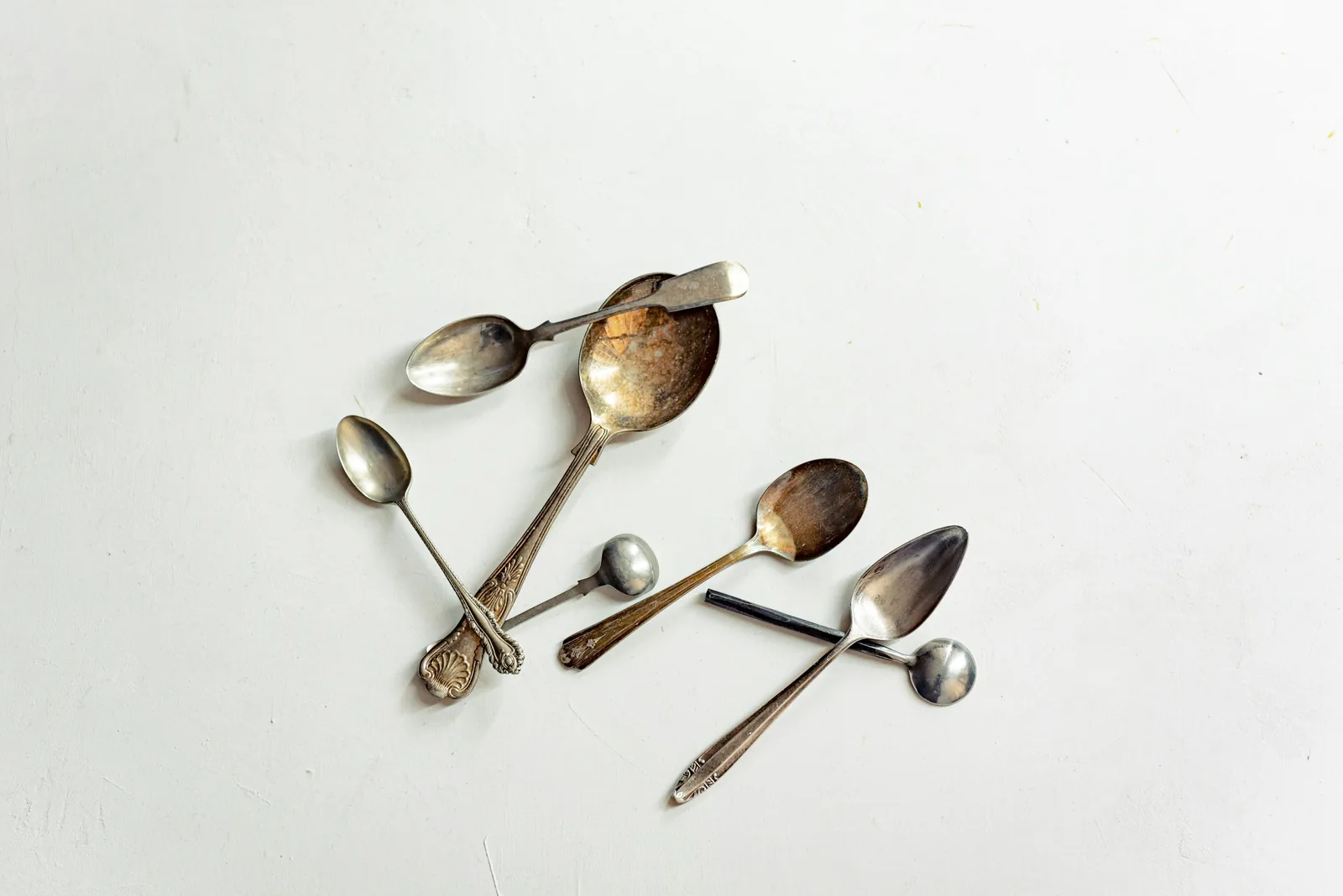
Sterling silver flatware value starts with one question: is it solid silver at all? Under federal law, a handle marked sterling must be at least 925 parts per thousand pure silver, while plate is a silver coating over another metal. Read the marks on the back of each handle, keep the set together, and leave the tarnish alone.
A silver chest usually comes out of a closet or the bottom drawer of a buffet, wrapped in the same cloth it's been in for decades. The first thing families ask is what the set might bring. The better first question is whether it's solid silver at all, because plenty of handsome silverware is plate.
Here's the short answer. Solid silver is silver all the way through, while plate is a silver coating over another metal, and that difference shapes everything that follows. Beyond the metal, a known maker, a wanted pattern, a full service and serving pieces can draw collectors. Most families have common patterns, and that's fine. We won't put a number on yours, but the marks on the back of the handles will tell you which conversation you're having before you talk to us about selling.
How to tell if silverware is sterling
Silverware is sterling when its silver is at least 925 parts per thousand pure. In the United States the word Sterling, the abbreviation Ster. or the number 925 on the back of a handle is the maker's claim that it meets that standard.
Federal law draws the line. Under 15 U.S.C. 296, an article may be marked sterling or sterling silver only if its silver is 925 one-thousandths pure, and coin or coin silver only at 900 one-thousandths, each with a tolerance of four one-thousandths. The Federal Trade Commission's guides on silver content, 16 CFR 23.5, list the words solid silver, sterling and Ster. among markings that may be misleading on anything below 925/1,000ths pure silver, and note that the National Stamping Act bars stamping silver-plated articles with the word sterling or the word coin.
- Turn a fork over and read the back of the handle in good light. A magnifying glass helps with small, worn marks.
- Look for the quality mark: a word, an abbreviation such as Ster., or a number such as 925 or 900. Write it down exactly, and bring your notes to the free consultation.
- Look for a maker's name or symbol beside it, and a pattern name if there is one.
- Look for plate wording, such as plate, plated or silverplate. Those words describe a coating, not solid silver.
- Check every piece, not just one. A drawer can pick up strays over the years, and one set can hide a few plated spoons.
- Set the knives aside and note them separately, since many knives pair a silver handle with a blade of another metal.
Coin silver and marks from other countries
Not every solid silver piece carries the 925 standard. Coin silver, at 900 parts per thousand under the same federal law, is its own standard. Silver from overseas is marked by that country's rules. In Britain, for example, the British Hallmarking Council's hallmarking guidance summary on GOV.UK says that under today's rules a complete hallmark has three compulsory marks: the sponsor's or maker's mark, a fineness mark giving the purity in parts per thousand, and the assay office mark, with a date letter optional. If you see a row of tiny symbols, photograph it and write down what you can; don't guess.
Sterling vs. silverplate: the back-of-the-handle key
Here's the tool we'd hand any family with a silver chest. The legal standards come from the federal sources above; the key itself is our editorial judgment, a way to sort pieces before anyone talks about value, not a test of metal content. We call it the back-of-the-handle key.
| Mark you see | What it usually means | What to write down |
|---|---|---|
| Sterling, Ster. or 925 | The maker is claiming sterling, 925 parts per thousand pure silver, the US legal standard for that word | The exact mark, the maker, the pattern, and how many pieces carry it |
| Coin, coin silver or 900 | The maker is claiming coin silver, 900 parts per thousand under the same federal law | The exact mark and maker |
| Plate, plated, silverplate or similar | A silver coating over another metal; federal law bars marking plated wares sterling or coin | The maker and pattern, kept apart from any solid silver |
| A row of small symbols | Possibly hallmarks from Britain or another country, which follow that country's system | A clear photo and a note of each symbol |
| No mark at all | Unknown. Unmarked does not mean worthless, and it does not mean solid | "Unmarked" and nothing more |
Our editorial guide, not a measurement. A mark is the maker's claim; it is not a test, and it says nothing about what a piece will bring.
Please don't scratch, file or acid-test anything to find out. Damage done to answer a question can't be undone, and a careful description of the marks answers most of it.
Sterling silver flatware value: what bidders weigh
Once you know what's solid and what's plate, the rest of the picture is fairly plain. This is our editorial reading of what bidders look at, not a measurement:
- Silver content. Solid or plated is the first thing a bidder wants to know, and the marks are how you show it.
- Maker and pattern. A known maker and a pattern collectors are trying to complete can draw interest beyond the metal.
- Completeness. A full service, matched place settings and serving pieces read very differently from a handful of strays.
- Condition. Bent tines, dents, heavy wear and repairs all belong in the description.
- The chest and paperwork. A fitted chest, original boxes and receipts help a buyer understand the set.
A good description sticks to facts rather than guesses. Our August 2026 catalog gave the weight of Lot 208, a small lot of chains, and photographed it right on the scale.
Before you sell: don't polish, don't split, don't melt
Tarnish worries families more than it needs to. Leave every piece as it is until Marv has looked at it: no polish, no dips, no buffing wheel. And don't throw anything away, including the dented spoon and the odd plated server, until Marv has seen it.
- Keep the set together, in its chest or boxes, with any cloth bags it came in.
- Don't split the set among relatives before you know what it is; a full service and four separate place settings are different things.
- Don't sell it by weight to the first buyer who asks before someone has looked at the maker and pattern. Once silver is melted, the pattern is gone for good.
- Write down monograms, receipts and the family story, such as a wedding gift or a set bought a place setting at a time.
- Count the pieces by type: dinner forks, salad forks, teaspoons, knives, serving pieces.
When to talk to the estate's attorney or personal representative
If the silver belongs to someone who has died, settle who has authority to sell it before anything leaves the house, especially when several heirs have strong feelings about one set. Our guide to transfer by affidavit in Wisconsin covers small estates; for anything else, the estate's attorney or personal representative is the right first call. This is general information, not legal advice.
Silver beyond the silverware drawer
Solid silver turns up in jewelry boxes, on dressers and in coin rolls too. Rings, chains, compacts and serving pieces get the same treatment: read the mark, keep matching pieces together, and leave the tarnish. If the drawer also holds silver coins, see our guide to silver dollar value. If the silver came out of a china cabinet, our guide to what to do with old china covers the plates beside it.
We run estate, household, antique and farm auctions from downtown Deerfield, about 15 minutes east of Madison, and all bidding happens online through HiBid. Every lot is numbered, described and photographed, so a collector hunting one pattern can find yours wherever they live. A silver chest can go into a full estate sale or be consigned on its own. Start with a free consultation, and bring your notes from the back of the handles.
Common questions
What does 925 mean on silverware?
It means the maker is claiming 925 parts per thousand pure silver, the US legal standard for the word sterling under 15 U.S.C. 296. A mark is a claim, not a test, so write it down exactly along with the maker's name. Federal law also bars stamping silver-plated wares with the word sterling or the word coin.
Is silverplate worth selling?
Often, as part of a household. Plate is a silver coating over another metal, so it carries little silver of its own, but complete sets, serving pieces and known makers still find buyers. We won't guess at values here. Keep plated pieces apart from solid silver, describe them honestly, and let Marv see them before deciding.
Should I polish sterling silver before I sell it?
No. Leave it as it is until Marv has looked at it. Tarnish worries families more than it needs to, and polishing, dipping or buffing changes the surface for good. Keep the set together in its chest, count the pieces by type, and bring your notes on the marks to the free consultation.
How can I tell sterling from silverplate with no mark?
Usually you can't, not reliably by eye. Please don't scratch, file or acid-test a piece to find out, because damage can't be undone. Write unmarked in your notes, keep the piece with the set it came from, and let someone experienced look at it in person. A missing mark is a fact worth noting, not a verdict.
What is coin silver?
Coin silver is its own standard. Under federal law, an article may be marked coin or coin silver only if its silver is 900 one-thousandths pure, a little below the 925 required for sterling. Treat a coin mark the way you would a sterling mark: write it down exactly, note the maker, and keep the pieces together.
Should I sell old silverware for scrap?
Not before someone has looked at the maker, the pattern and the set. A known pattern or a complete service can draw collectors who want more than the metal, and once a piece is melted the pattern is gone for good. Leave everything together and as it is, and talk it through at the free consultation first.
Can I sell just a silver set at auction?
Often, yes. Single pieces and single collections are consigned into our sales regularly, alongside full estates. Call Marv at (608) 628-1631, describe the set, the marks and the number of pieces, and keep a few photos handy. If an auction isn't the right route for your silver, he'll tell you that instead of taking it.
Sources
- 15 U.S. Code 296: Standard of fineness of silver articles; deviation, Legal Information Institute, Cornell Law School
- 16 CFR 23.5: Misrepresentation as to silver content, Legal Information Institute, Cornell Law School (Federal Trade Commission guides)
- Hallmarking: practical guidance, summary, British Hallmarking Council, on GOV.UK