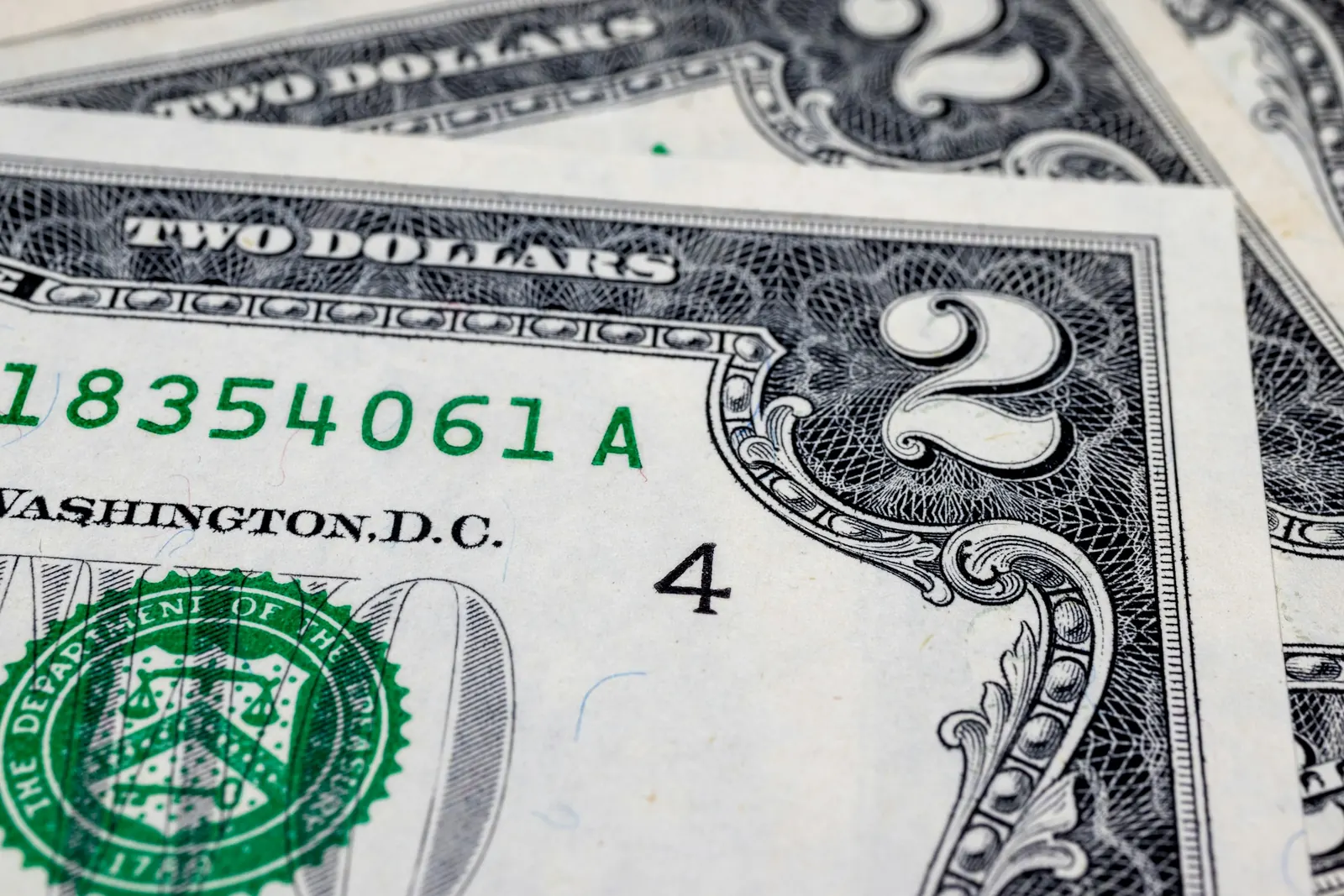
Most $2 bills are ordinary money you can spend at face value. The note is still issued, and the Federal Reserve counted 1.8 billion of them in circulation at the end of 2025. Collectors look twice at red-seal notes, oversized pre-1929 notes, star notes and crisp, unfolded examples.
Every few months a post goes around claiming the $2 bill in your drawer could pay for a vacation. It usually shows a high asking price from an online listing, and it rarely says whether anyone actually paid it. Families settling an estate see those posts, open Grandpa's envelope of crisp Jeffersons, and wonder what they have.
Here is the honest answer. Most $2 bills are common, current money. A few older or unusual notes draw real interest from collectors, and the clues that separate them are printed right on the bill. This guide shows you those clues, then what to do next.
Are $2 bills worth anything more than face value?
Usually not. A green-seal note from Series 1976 or later is a current Federal Reserve note, the same design still issued today. Extra collector interest comes from age, seal color, size, a star in the serial number and condition, not from the denomination itself.
The Bureau of Engraving and Printing's $2 note page lists Series 2017A as the most recent printing and says there are no plans to redesign the note. The Federal Reserve's currency in circulation table counted 1.8 billion $2 notes outstanding as of December 31, 2025, up from 1.4 billion four years earlier. That is not a rare object. It is a working denomination that people simply don't see much at the register.
Old ones still spend, too. The government's currency site says in its history of US currency that all US currency issued since 1861 remains valid and redeemable at full face value. If the estate also holds coins, our guide on how to sell a coin collection covers the same keep-it-together approach.
Why the two dollar bill feels rare when it isn't
The $2 bill has a reputation problem, and the government's own currency education podcast says so. In the episode "Much Ado About the Two," a speaker puts it plainly: "People think that the two is rare and so it's treated that way." One of the hosts admits she held onto one simply because she didn't see them often.
That habit explains the estate drawer. People got one as change, a gift or a tip, thought it was special, and tucked it away. Repeat that in household after household and you get a note that feels scarce in daily life but turns up in a great many dresser drawers. Unfamiliar is not the same as rare.
Viral posts lean on the gap. An online asking price is a hope, not a result, and a headline about one unusual note says nothing about the ordinary note in your hand. The same pattern drives the stories about pennies; our guide to the penny being discontinued walks through that one.
The teller window test: two dollar bill value in one question
Here is the quick sort we suggest. It is our editorial guide, not a measurement: could a bank teller hand you this exact note today? If yes, it is ordinary money, however crisp it looks. If no, because the design, seal or size is no longer issued, set it aside for someone who knows paper money to look at.
| What you see | What it means | What to do |
|---|---|---|
| Green seal, Series 1976 or later, the signing scene on the back | A Federal Reserve note in the design still issued today | Ordinary money; keep it with the rest so nothing gets mixed up |
| A star printed in the serial number (on modern notes it takes the place of the last letter) | A replacement note printed during production | Set it aside for a closer look |
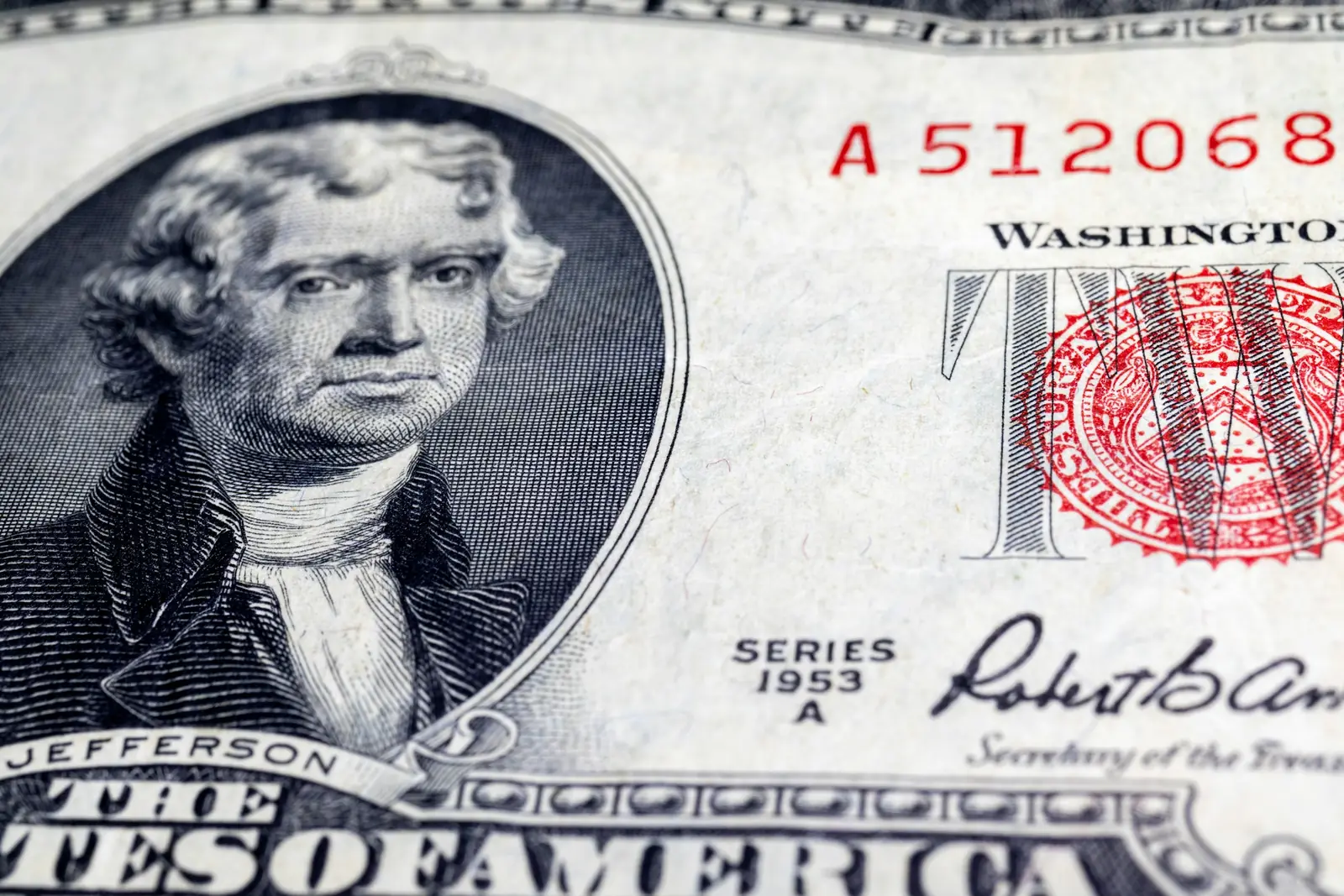
| Red seal and red serial numbers, Monticello on the back | A United States Note, a class no longer issued | Set it aside for a closer look |
| Noticeably larger than a modern bill | Printed before notes were made smaller in 1929 | Set it aside for a closer look |
| Writing, stamps, tape, tears or heavy folds | Condition matters on any note, old or new | Leave it exactly as it is |
Sources: the star suffix, United States Notes and the 1929 size change are described on uscurrency.gov; the Series 1976 design is on the BEP's $2 note page.
Each clue comes from an official description. The government's banknote identifiers page says a star suffix identifies notes that serve as replacements during production, and that a capital letter after the series year appears when there is a significant change in the note. Its history page dates the move to today's smaller notes to 1929, when notes were made about 30 percent smaller.
Red seal $2 bills and other older notes
Before 1976, the $2 bill most families find was a different kind of money. The BEP says the Series 1928 $2 United States Note was the first to put Jefferson's home, Monticello, on the back, and that Series 1976 replaced it with an engraving of John Trumbull's painting of the Declaration of Independence. United States Notes carry a red seal and red serial numbers, and uscurrency.gov's history says no new ones were placed into circulation beginning in 1971.
Our August 2026 sale offered exactly that pairing as Lot 243: a Series 1953-B red-seal $2 note with a 1957-B $1 silver certificate. Its front shows folds and handwritten marks, the kind of honest wear most saved notes carry. A red seal tells you a note is older, not that it is scarce; series, condition and serial number still decide how much interest it draws. Blue-seal silver certificates are their own story, told in our guide to silver certificate value.
What to do with a drawer full of $2 bills
Whether you found one note or a bank strap of them, the first job is to keep from undoing anything. Here's the order we suggest:
- Leave every note as you found it. Don't flatten, press, wash, tape or trim anything, and leave notes in their envelopes, sleeves or straps.
- Don't spend the odd ones. Green-seal notes from 1976 on can go back into your wallet later; red seals, stars and oversized notes wait.
- Make a simple list. Write the series year, seal color and whether the serial number includes a star. Photograph notes where they sit.
- Keep paper money with the coins. Collections were often built together, and our estate cleanout guide explains why nothing should be tossed before someone looks.
- Confirm who can sell. If the owner has died, settle who has legal authority to sell before anything leaves the house.
- Call before you sort further. Describe what you have on our sell with us page or by phone.
When an auction makes sense for old paper money
Coins and currency run through our past catalogs, from Buffalo nickels and Peace dollars to silver certificates and proof sets. A single envelope of notes can go into a sale on its own, or sit beside the rest of the estate. Each lot is numbered, described and photographed, then bidding runs for about a week on HiBid and ends on a soft close.
Not every note needs an auction. A stack of green-seal 1976 and later notes is money you can deposit. Older notes, mixed envelopes and full collections are where competitive bidding earns its keep, because collectors who know series and serial numbers are the ones who notice the difference. If the drawer also holds silver coins, our silver dollar value guide is a good next read.
Marv Dorshorst, Registered Wisconsin Auctioneer #344, will look before anything is decided. Call (608) 628-1631, or check current and upcoming auctions to see how coins and currency appear in a real catalog.
Common questions
Is a 1976 $2 bill rare?
Usually not. Series 1976 is the first series of the green-seal design the Bureau of Engraving and Printing introduced for the bicentennial, and the same design is still issued, most recently as Series 2017A. A 1976 date alone doesn't set a note apart. Collectors look at condition and the serial number, such as a star at the end.
Can you still spend an old $2 bill?
Yes. According to uscurrency.gov, all US currency issued since 1861 remains valid and redeemable at full face value. That includes red-seal United States Notes. Before spending an older note, though, set it aside: red seals, star notes and oversized pre-1929 notes are the ones collectors look at twice, and once spent they're gone.
What is a red seal $2 bill?
A red seal $2 bill is a United States Note, an older class of paper money with a red Treasury seal and red serial numbers. The government stopped placing new United States Notes into circulation beginning in 1971. Those with Monticello on the back predate the 1976 redesign. Red alone doesn't make one scarce; series and condition matter.
What does a star on a $2 bill mean?
A star in the serial number marks a replacement note; on modern notes it replaces the last letter. The government's currency site says star notes replace notes found defective during production at the Bureau of Engraving and Printing. Collectors pay attention to star notes, so keep any you find separate and leave them exactly as they are.
Do banks still give out $2 bills?
The Federal Reserve still issues the $2 note, and 1.8 billion of them were in circulation at the end of 2025. Whether a particular bank branch keeps them in the drawer varies, so ask yours. Green-seal notes are legal tender and can be deposited like any other currency.
How do I sell old $2 bills from an estate?
Keep the notes together and unchanged, list the series, seal color and any star serial numbers, and confirm who has authority to sell. Then talk to an auctioneer before sorting further. Dorshorst Auctions consigns single collections into its online sales, and the first consultation with Marv is free and carries no obligation.
Sources
- $2 Note, Bureau of Engraving and Printing
- Currency in Circulation: Volume, Board of Governors of the Federal Reserve System
- History of US Currency (archived timeline), U.S. Currency Education Program, uscurrency.gov
- Much Ado About the Two (Noteworthy podcast), U.S. Currency Education Program, uscurrency.gov
- Banknote Identifiers, U.S. Currency Education Program, uscurrency.gov