Mid century modern furniture is the clean-lined modern furniture of roughly the 1940s through the 1960s. To tell what you have, check four clues in order: shape, material, construction and label. Some famous designs are still made today, so a look or even a name alone doesn't prove age.
The look is everywhere again: low walnut credenzas, molded plywood chairs, tapered legs, the living rooms that Mad Men put back on television. So when a family opens Grandma's spare room and finds a teak dresser or a pair of shell chairs, the first question is usually whether it's "real MCM."
The honest answer takes a few minutes of looking. Plenty of what turns up in a family house is good production furniture in the style. A few pieces are designer originals. Some are recent pieces that only look the part. Shape, material, construction and label, checked in that order, sort most of it, and none of it requires a refinishing kit. For the rest of the house's wood furniture, see our guide to brown furniture.
What counts as mid century modern furniture
Mid century modern furniture is the clean-lined, lightly built modern furniture designed and made from about the 1940s into the 1960s, in walnut, teak, molded plywood, fiberglass, wire and aluminum, usually on slim tapered or metal legs.
The shift started before the war. The Henry Ford's history of the Herman Miller company credits designer Gilbert Rohde with helping move the American furniture industry from historical revivals toward a modern look; after Rohde died in 1944, George Nelson became the company's director of design. The Library of Congress notes that Charles and Ray Eames designed chairs for Herman Miller in four materials: molded plywood, fiberglass-reinforced plastic, bent and welded wire mesh, and cast aluminum. Their molded plywood chairs were unveiled to the public in 1946.
Those names are the famous end of the era. Many American and Scandinavian factories made furniture in the same spirit for ordinary homes, and plenty of it still sits in Wisconsin bedrooms and basements. If you're settling an estate, our guide to what an estate auction is explains how a whole household gets sold.
The four-clue check: shape, material, build, label
Here's the order we'd suggest for identifying mid century modern furniture. It's our editorial guide, not an authentication method, and the order is the point: the label comes last, because it's the clue people trust too fast.
1. Shape
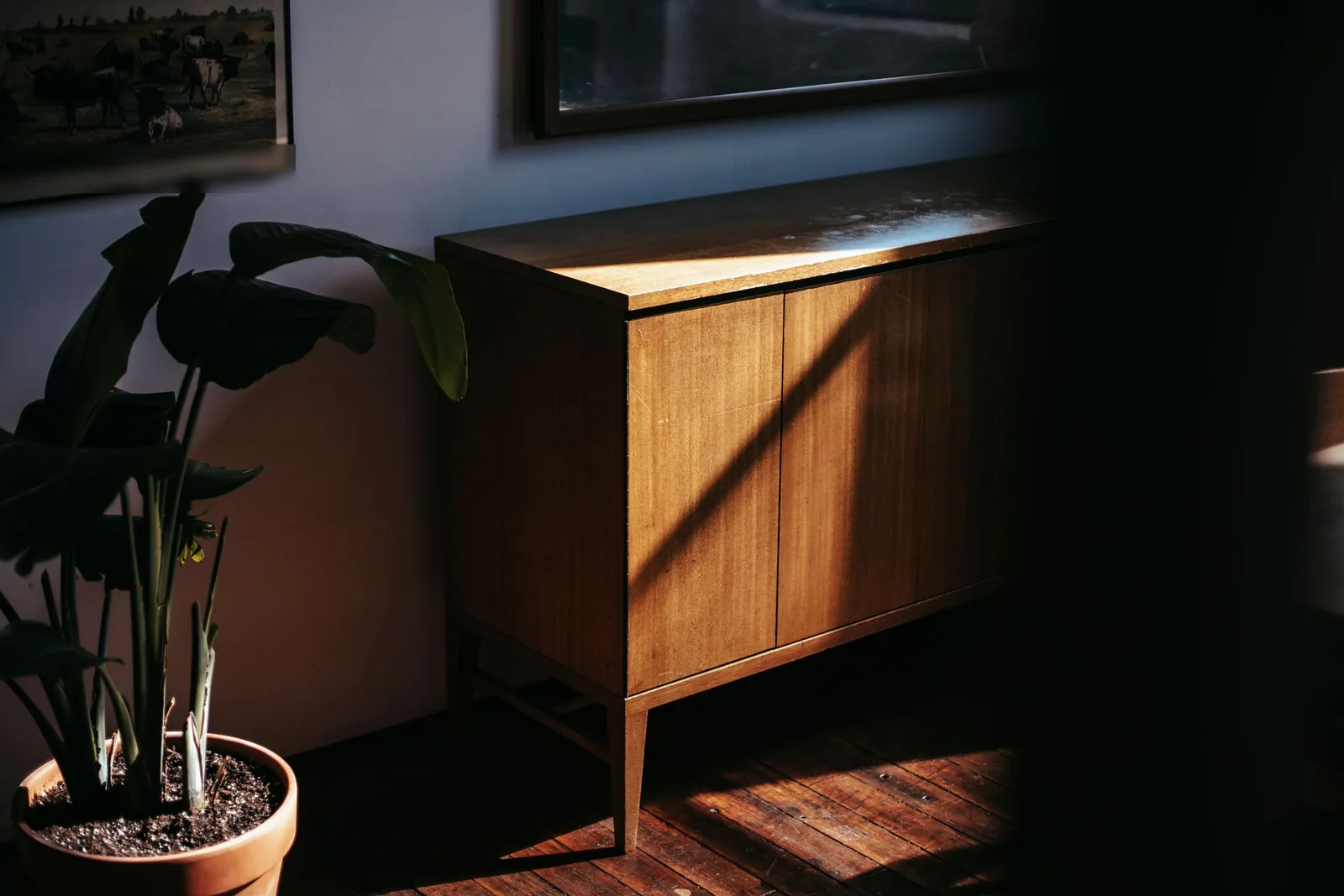
Look for low, long cases, legs that taper or splay, drawers without heavy carved fronts, and seats that float on thin frames. Shape tells you the style. It can't tell you the decade, because the style has been copied ever since.

2. Material
Note the wood (walnut, teak, oak, birch), any molded plywood, fiberglass, wire or cast aluminum, and whether the surfaces are solid wood, a wood veneer or a printed laminate. Write down what you see; don't sand or oil anything to find out.
3. Build
Pull a drawer and look at the corners, the drawer bottom and the back panel. Check how the legs attach and whether hardware looks original or added later. Wear should match use: edges, drawer runners and armrests show age first.
4. Label
Look inside drawers, on the back and under seats for a paper label, a metal tag or a stamp. The Henry Ford's collection includes a Nelson desk from about 1958 to 1968 in walnut veneer and chrome steel, with a round metal label naming George Nelson and Herman Miller. A label tells you who made a piece. It doesn't always tell you when.
| Clue | What to look at | What it can't prove |
|---|---|---|
| Shape | Low cases, tapered or splayed legs, thin frames | Age: the style is still copied |
| Material | Walnut, teak, molded plywood, fiberglass, wire, aluminum; solid, veneer or laminate | The maker |
| Build | Drawer corners, back panels, leg joints, hardware, wear | A famous name |
| Label | Paper labels, metal tags, stamps inside drawers and under seats | The date, when a design stayed in production |
Our editorial guide, not a measurement or an authentication. Bring your notes and photos to the consultation.
Original, later production or look-alike?
This is where most mistakes happen. The Library of Congress points out that variations of the Eames molded plywood designs are still in production, so a chair can be an authentic design from the right company and still be a recent one. Meanwhile, stores sell new furniture "inspired by" the era, and older factory lines borrowed the look as well.
- An early original shows its age in wear, construction and label together.
- A later licensed version can carry the right name with newer labels, parts or materials.
- A look-alike has the shape but no maker's mark, or a mark from a different company entirely.
- A good period production piece came from a factory that never had a famous designer, and still has buyers of its own.
None of these is a bad thing to own. They are different things to sell, and the description should say which one it is. Our guide on how to sell antique furniture covers the same habit of recording evidence instead of guessing.
Mid century modern furniture value: what decides interest
Online listings use "MCM" for everything from designer originals to new look-alikes, and an asking price is not a sold price. What actually decides how much interest a piece draws is plainer:
- Who made it, and whether a label or the construction backs that up.
- Originality: original finish, hardware, upholstery frames and legs.
- Condition that matches honest use, with damage noted plainly.
- Completeness: shelves, pulls, leaves, matching pairs and sets kept together.
- Form and size: chairs, small cases and pieces that fit today's rooms tend to find more people who can use them.
That last point is our editorial judgment, and it echoes what's happening with older wood furniture in general. The same house often holds a Lane cedar chest from the same decades; read that guide before a child can get near it, because CPSC urges owners to remove the old lid lock from Lane chests made between 1912 and 1987.
Leave it as it is until someone has looked
A veneer is a thin layer of wood, and sanding can go right through it. The safest rule for a seller is the simplest: no oil, no polish, no new upholstery and no swapped pulls before Marv has looked at it. Keep loose parts with the piece, leave labels and stamps where they are, and photograph any damage instead of fixing it.
Before anything leaves the house, our estate cleanout guide explains why the plain-looking pieces deserve a second look too.
Selling mid century modern pieces with the rest of the estate
An auction suits this furniture because the right buyer is rarely the person next door. All bidding on our sales happens online through HiBid, every lot is numbered, described and photographed, and bidders can look over the photos before they bid. Pottery such as McCoy and Royal Haeger turns up in our catalogs alongside the furniture, and Lot 192 above was listed as mid century.
If you're selling, start with a free consultation and bring your notes from the four-clue check. If you're hoping to buy, check current auctions or get sale announcements by email, since most days no sale is open.
Common questions
How do I know if my furniture is mid century modern?
Check four clues in order: shape (low lines, tapered or splayed legs), material (walnut, teak, molded plywood, fiberglass, wire or aluminum), construction (drawer corners, back panels, hardware and wear) and label (paper labels, metal tags or stamps). No single clue settles it. Write down what you find and photograph it before deciding anything.
What years are considered mid century modern?
Roughly the 1940s through the 1960s. The Library of Congress dates the public debut of the Eames molded plywood chairs to 1946, and The Henry Ford dates one Nelson desk in its collection to about 1958 to 1968. The look has been copied ever since, which is why a date needs evidence beyond the shape.
Does a Herman Miller label mean my chair is vintage?
Not necessarily. A label tells you who made a piece, not always when. The Library of Congress notes that variations of the Eames molded plywood designs are still in production, so a genuine piece can be recent. Wear, construction and the style of the label all add evidence. Leave the label exactly where you found it.
Is MCM furniture worth anything?
Some of it draws real interest and some doesn't. What decides it is who made it, how original and complete it is, its condition and whether its size suits today's rooms. Listings call almost anything MCM, and asking prices are not sold prices. Have the piece looked at before you refinish, repaint or give anything away.
Should I oil or refinish a teak or walnut dresser before selling it?
No. A veneer is a thin layer of wood, and sanding or refinishing can't be undone. Buyers also judge originality from the finish. Keep the parts together and leave the piece as it is until Marv has looked at it. Photograph any damage instead of trying to fix it.
Can I sell one mid century chair or dresser at auction?
Often, yes. Single pieces and single collections get consigned into our sales regularly. Call Marv at (608) 628-1631 with photos of the whole piece, any label and the inside of a drawer handy, so he can see what the four clues show. If an auction isn't the right route for it, he'll say so.
Sources
- The Work of Charles and Ray Eames: Furniture, Library of Congress
- Herman Miller and The Henry Ford, The Henry Ford
- Nelson Desk, circa 1958-1968, The Henry Ford