

If your Lane cedar chest was made between 1912 and 1987, deal with the lock first. CPSC urges owners to completely remove the old latch and lock, because the lid locks automatically and children have suffocated inside. Replacement locks are no longer available (CPSC note, January 31, 2023). After that, style, condition and originality decide interest.
Lane cedar chests sat at the foot of beds in Wisconsin homes for generations, and plenty of them are still there. When a family settles an estate, the first question is usually what the chest is worth. The first question should be about the lock.
Older Lane chests were built with a latch that locks the lid automatically when it closes. Children have climbed in and been unable to get out. This guide gives the federal safety warning exactly as the U.S. Consumer Product Safety Commission (CPSC) states it, dated, and then covers how to identify your chest and what decides interest in it when it's time to sell. If you're clearing a whole house, our guide to what an estate auction is explains the bigger process.
The Lane cedar chest recall, in CPSC's words
In its July 11, 2018 release, CPSC says the chests were recalled "because the chest's lid automatically locks when the lid is closed." Fourteen children suffocated inside these cedar chests after becoming locked inside between 1977 and 2015. In 1996, The Lane Company recalled 12 million cedar chests with latches that automatically locked the lid when it was closed.
The remedy changed. A note on the same CPSC page, dated January 31, 2023, says United Furniture Industries (UFI) of Tupelo, Mississippi "is no longer administering the recall and replacement latches and locks are no longer available." CPSC "urges consumers to completely remove the locks from their recalled Lane and Virginia Maid brand chests to eliminate the hazard," and says the announcement will be updated if a replacement remedy becomes available again. When we checked the page on November 15, 2026, that note was still posted.
CPSC also says the old style latches on all "Lane" and "Virginia Maid" brand cedar chests manufactured between 1912 and 1987 should be immediately removed, and that the chests can be identified by the brand name located inside the chest. It adds that these chests are often handed down through families or bought second-hand, which describes most chests that turn up when a family is clearing out a parent's house.
Why older articles mention free locks
When the recall was announced on September 4, 1996, Lane offered free, redesigned safety locks, and the release said that by 1987 Lane had begun building all of its cedar chests with redesigned locks. That offer is why old newspaper stories and forum posts tell you to call for a replacement. As of the CPSC note above, replacements are no longer available, so removal is the remedy.
What to do with a Lane cedar chest at home
These steps follow CPSC's published advice. They're about safety, not resale.
- Look inside the chest for the brand name "Lane" or "Virginia Maid," the identification CPSC gives.
- Treat a chest made between 1912 and 1987 as covered. If you can't tell when it was made, don't assume it's newer.
- Remove the latch and lock completely, as CPSC urges. Don't wait for a replacement part; CPSC says none is available.
- Check other chests and trunks too. For chests not recalled but fitted with an automatic latch, CPSC's 2014 storage chest warning says to disable or remove the lock and check with the maker about replacement hardware.
- Remove the latch before the chest is sold or given away, and tell Marv when you call whether that's done.
That 2014 warning lists cedar chests, cedar trunks, cedar boxes, hope chests, blanket chests and storage trunks among the types with these hazards, so the same check applies to the old trunk in the attic. CPSC's releases also state that federal law prohibits any person from selling products subject to a Commission ordered recall or a voluntary recall undertaken in consultation with the CPSC, and the 2014 warning urges consumers not to purchase or sell any recalled chest that has not been repaired. A recalled chest with the old latch still on it should not be offered for sale anywhere, so ask Marv before you plan on selling one.
The latch-first order: our way to handle a Lane chest
Families often do this in the wrong order: they search for a price, then list the chest, then think about the lock. We'd suggest the reverse. This order is our editorial guide, not a CPSC procedure:
| Step | What you do | Why it comes here |
|---|---|---|
| 1. Latch | Follow CPSC: remove the old latch and lock | A child's safety comes before everything else |
| 2. Label | Find the brand name inside; note any stamped numbers underneath | It tells you what you have and whether the recall applies |
| 3. Condition | Photograph the finish, feet, hardware and lining as they are | This is what a buyer judges |
| 4. Sale | Call with photos and notes | Now the selling conversation can start honestly |
Our editorial guide, not a measurement or an official procedure. CPSC's instructions govern step 1.
How to identify your Lane cedar chest
Start where CPSC does: the brand name inside the chest. Then look underneath and inside the lid for stamped numbers, paper labels or a store's name, and write down exactly what you find without scraping or sanding anything. The 1996 release notes that furniture stores sold the chests nationwide in a variety of styles, sizes and colors, so two Lane chests can have little in common beyond the name.
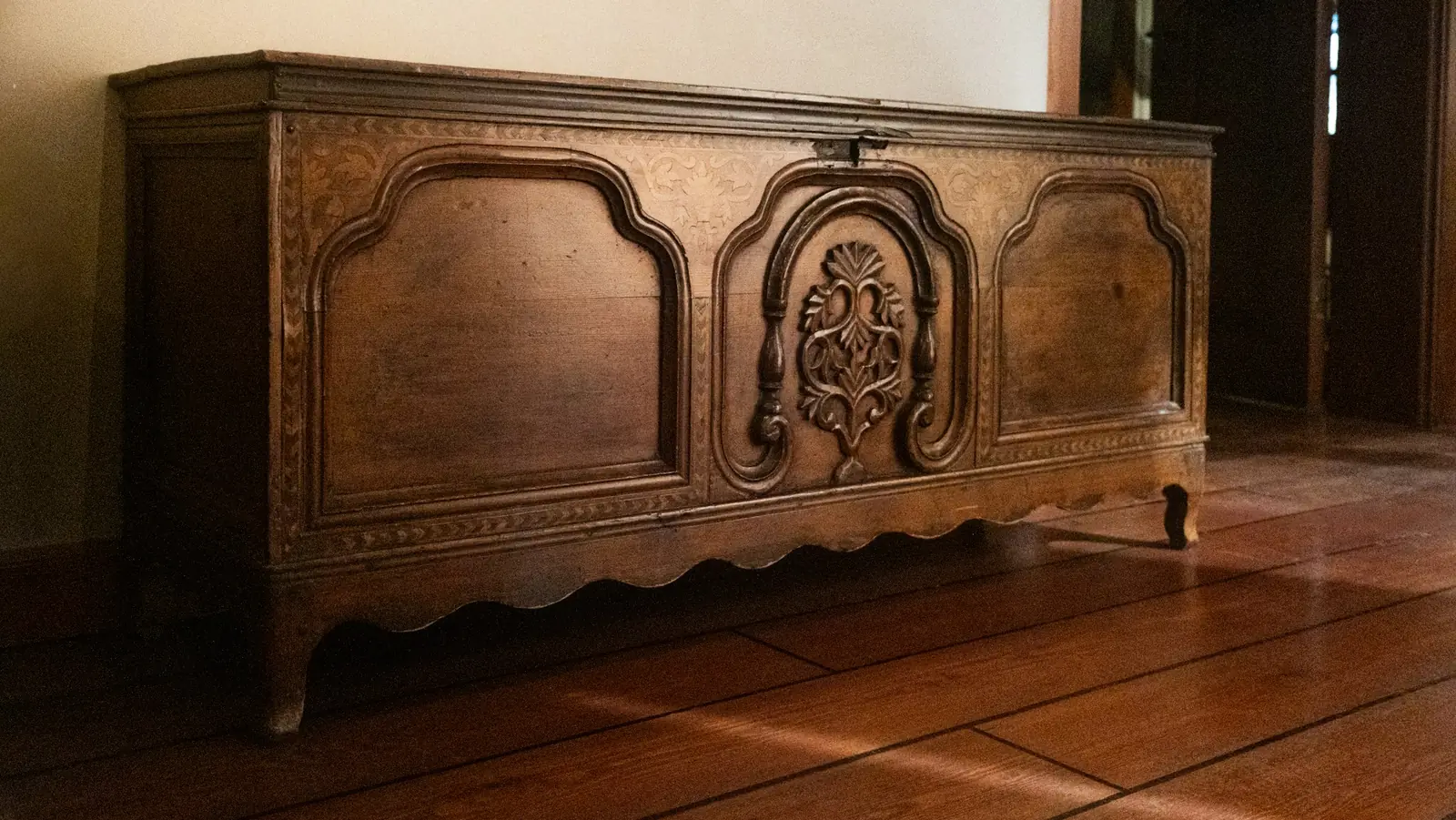
- Style: note the shape of the front, the feet or base, and any carving or contrasting veneer.
- Size: height, width and depth, plus whether there's a tray or drawer inside.
- Lining: whether the cedar lining is intact, cracked or patched.
- Hardware: handles, hinges, lid supports and whether the latch has been removed.
- Paper: any receipts, cards or family notes kept inside the lid.
If your chest has the low lines and tapered legs of the 1950s and 1960s, our guide to identifying mid century modern furniture applies too.
Lane cedar chest value: what decides interest
Here's the honest short answer: most Lane cedar chests are common. The 1996 CPSC release says Lane made approximately 12 million of them from 1912 to 1987. That doesn't mean yours draws no interest. It means interest comes from the particular chest, not the name alone:
- Style and era: some designs draw more attention than the everyday ones.
- Condition: veneer lifting, water marks, broken feet and a cracked lining all count.
- Originality: original finish, feet and hardware, with nothing swapped or repainted.
- Size: a chest that fits at the foot of a modern bed is easier for more people to use.
- Honesty about the lock: be ready to say plainly whether the old latch is gone.
Asking prices online are not sold prices, and a guess from a photo of a different chest tells you little about yours. The wider story of older wood furniture, and why small pieces fare better than big formal sets, is in our guide to brown furniture.
Leave the finish and the cedar as they are
Removing the latch is a safety step. Everything else waits. No refinishing, no new stain, no sanding the lining to bring the cedar smell back, and no swapped handles before Marv has looked at it. A buyer judges age and originality from the surfaces you'd be changing, and our guide on how to sell antique furniture explains why that evidence matters.
When the chest goes with the rest of an estate, all bidding on our sales happens online through HiBid, every lot is numbered, described and photographed, and larger lots are pickup only. We work out of downtown Deerfield, about 15 minutes east of Madison, and antique furniture and trunks are among the categories in our past catalogs. Start with a free consultation and mention the lock when you call.
Common questions
Are all Lane cedar chests recalled?
CPSC says the old style latches on all Lane and Virginia Maid brand cedar chests made between 1912 and 1987 should be removed immediately. The 1996 release said that by 1987 Lane had begun building all its chests with redesigned locks. For any other chest with an automatic latch, CPSC says to disable or remove the lock.
Can I still get a replacement lock for a Lane cedar chest?
According to a CPSC note dated January 31, 2023, no. United Furniture Industries is no longer administering the recall, and replacement latches and locks are no longer available. CPSC urges owners to completely remove the locks instead. The note was still posted when we checked on November 15, 2026; CPSC says it will update the page if a replacement returns.
How do I tell how old my Lane cedar chest is?
Look inside for the Lane or Virginia Maid name, then check underneath and inside the lid for stamped numbers, labels or a store's name, and write them down. Style, feet and hardware add clues. If you can't establish when it was made, don't assume it's newer than 1987; follow CPSC's advice on the latch.
Is a Lane cedar chest worth anything?
Most are common, since CPSC's 1996 release says Lane made about 12 million between 1912 and 1987. Interest depends on the particular chest: its style, condition, originality, size and whether the old latch has been removed. Asking prices online aren't sold prices. Have it looked at before you refinish, repaint or give it away.
Is it safe to buy a used cedar chest at an auction or yard sale?
Check the lock before you buy. CPSC urges consumers not to purchase or sell any recalled chest that has not been repaired. Look inside for the Lane or Virginia Maid name; if an old automatic latch is still on it, remove it completely, as CPSC urges. Check other chests and trunks for automatic latches too.
Should I sand the inside of a cedar chest before selling it?
No. Sanding the lining or refinishing the outside changes the surfaces a buyer uses to judge age and originality, and it can't be undone. The only change to make before a sale is the safety one: removing the old automatic latch as CPSC urges. Leave everything else as it is until Marv has looked at it.
Sources
- CPSC Urges Consumers to Replace or Remove Latches/Locks on Lane and Virginia Maid Cedar Chests; 14 Deaths Reported (July 11, 2018; note dated January 31, 2023), U.S. Consumer Product Safety Commission
- CPSC, The Lane Furniture Company Announce Recall for In-Home Replacement of Locks on Cedar Chests (Release 96-186, September 4, 1996), archived, U.S. Consumer Product Safety Commission, via the U.S. Government web archive
- CPSC Warns Consumers of the Deadly Dangers of Storage and Toy Chests (March 5, 2014), U.S. Consumer Product Safety Commission