
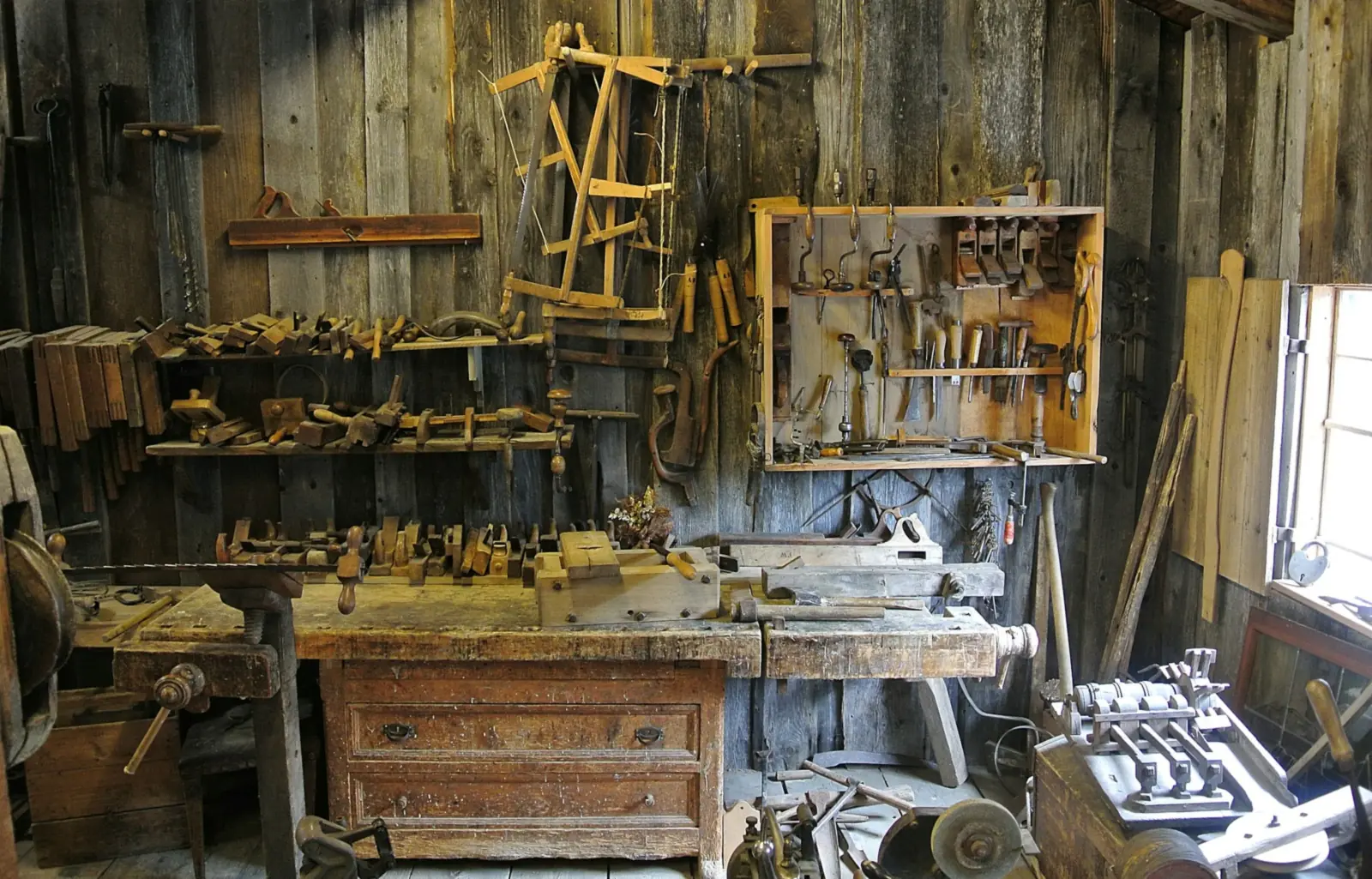
Don't haul old tools to the curb before someone who knows them has looked. Named makers draw collectors, working tools of any brand draw people who will use them, and some things need proper recycling. Keep what the family wants, sell the rest at auction, and send dead rechargeable and car batteries to recycling, never the trash.
A parent's garage can hold three generations of tools in one room: a carpenter's chest from the 1940s, a 1970s socket set, and cordless drills bought last spring. Our August 2026 sale alone carried vintage Stanley, Disston, Starrett and Miller Falls hand tools next to cordless kits. Most of that has a next owner somewhere. Some of it truly doesn't, and those pieces need the right disposal, not the trash can.
This guide is for families facing a full garage or workshop, often in the same weeks as a funeral and a house closing. It gives you one question to ask of every tool, the makers bidders recognize, what to recycle and how, and how to sell the rest. If the garage is part of a whole household, our guide to estate cleanout covers what else to hold on to.
Before you sort old tools: three things not to do
The first instinct is to tidy up. Three common first moves make the job harder:
- Don't throw anything away until Marv has looked. The items people assume are worthless are often the ones that draw the most attention, and a rusty plane or a box of odd chisels can be one of them.
- Don't clean, sharpen, oil or refinish. Leave rust, paint and worn handles as they are until Marv has seen them. Scrubbing can wear away the maker's marks a bidder looks for.
- Don't split chests and sets. A carpenter's chest with its trays, a socket set on its rail, or a drill with its charger is easier for a bidder to judge as a group.
Then call for the free consultation before the garage gets sorted by anyone else.
The Next-Owner Test for old tools
Age alone doesn't tell you what to do with an old tool. Who would pick it up next does. Here is the test we suggest. It is our editorial guide, not a measurement or a rule, and you can ask it of each tool, or each drawer, without moving anything.
| Next owner | What tends to fit | What to do now |
|---|---|---|
| Someone who will use it | Working hand tools, socket sets, levels, clamps, cordless kits with batteries and chargers | Leave it as is; keep kits with their chargers and batteries |
| A collector | Named makers and models: Stanley planes, Disston saws, Starrett measuring tools, Miller Falls drills | Leave marks, rust and handles alone; let Marv see them |
| Nobody, after a look | Damaged batteries and truly broken pieces | Recycle the right way; rechargeable and car batteries never go in household trash |
Our editorial guide, not a measurement. Many garages hold all three, sometimes in the same drawer.
Odds and ends don't need a verdict one by one. They can travel together as a box lot. Lot 98 from our August 2026 sale, for example, put Stanley wood chisels and scrapers in one box with a needle file set and a Snap-on 1/2-inch wrench.
Old tools worth money? The makers bidders recognize
We can't tell you what any one tool will bring, and nobody can honestly say without seeing it. What we can share is which names turn up in our catalogs and why collectors know them. In our editorial judgment, what catches a collector's eye is a named maker, a model number they can look up, original parts and marks they can still read.
Disston handsaws
Henry Disston opened his own saw shop in Philadelphia in 1840, according to the Encyclopedia of Greater Philadelphia, and built his Keystone Saw Works into the largest saw manufacturer in the world before family members sold the firm in 1955. That long run is one reason the name still turns up in old tool lots, ours included: lot 104 paired Disston and Atkins handsaws with two metal squares and a 23-inch wrecking bar.
There is no single Disston saw value. The type of saw, the condition of the blade and handle, and whether the maker's marks can still be read all matter, and that is for bidders to weigh, lot by lot.
Stanley planes and the rest of the bench
Stanley Rule and Level was organized in New Britain, Connecticut, in 1857 and made levels, squares and the Bailey plane. By 1900 it was the largest manufacturer of planes and related tools in America, according to Connecticut History, a CT Humanities project, and Stanley Works bought the business in 1920.
Starrett and Miller Falls are two more names from the same August catalog. Lot 56 paired a Miller Falls #77A hand drill with a Stanley #H10Z block plane, and lot 94 was listed as a vintage Starrett combination with a 12-inch #4 graduated blade. Mechanics' tools are their own story; see our guide to used Snap-on tools.
Cordless tools and batteries: what never goes in the trash
Cordless kits belong in the someone-will-use-it column when they work. Keep each tool with its batteries and charger, and note whether they worked the last time anyone tried. Lot 176 in our August 2026 sale was listed as an 18-volt Porter Cable box lot with two batteries and a charger, all working.
Batteries that are damaged or dead and won't go into a sale need care. The EPA's guidance on used household batteries, updated July 2026, says lithium-ion batteries should never go in household garbage or recycling bins, and suggests taping the terminals or bagging each battery to prevent fires. The Wisconsin DNR's page on proper handling of used batteries points to retail collection programs for rechargeables and notes that state law bans lead-acid batteries, like the old car battery on a garage shelf, from landfill disposal.
Ask before you recycle anything that still charges. A working battery may belong with its tool, and that is easy to settle at the consultation.
How to sell old tools at auction
An online auction puts users and collectors in front of the same catalog, which is the point of the Next-Owner Test. Here is how a sale with us runs:
- Confirm who can sell. For a small Wisconsin estate, see transfer by affidavit; if the estate is in probate, our guide to how long probate takes in Wisconsin covers the timeline.
- Call Marv at (608) 628-1631 or use the seller form for a free, no-obligation consultation.
- Walk through the garage together. We look at everything before anything is discarded.
- Every lot is numbered, described and photographed, and bidding runs on HiBid for roughly a week, ending on a soft close.
- Buyers pick up in a posted window, and small lots can ship.
- You get a settlement with a clear accounting of what sold and for how much.
One chest or a single collection can be consigned into a sale, too; our guide to the consignment auction explains how. Farm families clearing a shop along with machinery can start with our farm retirement auction guide.
Common questions
Are old hand tools worth anything?
Many are worth offering, but nobody can put a figure on a tool without seeing it. Interest depends on the maker, the model, condition, original parts and whether the marks are readable. Common tools are common. Leave everything as it is and let Marv look before you decide what to keep, sell or recycle.
What is the best way to get rid of old tools?
Ask who would pick each tool up next: someone who will use it, a collector, or nobody. Keep what family members want, sell what has a next owner, and recycle only what is truly done. Rechargeable and car batteries go to a recycling program, never household trash. Call Marv before anything leaves the garage.
Should I clean rusty tools before selling them?
No. Leave rust, paint and worn handles exactly as they are until Marv has seen them. Scrubbing, sharpening or refinishing can wear away the maker's marks and stamps a bidder reads first, and it can't be undone. Take photos if you like, but put the wire brush and the oil can away.
How do I dispose of old cordless tool batteries in Wisconsin?
The EPA says lithium-ion batteries never go in household garbage or recycling bins; tape the terminals or bag each one. The Wisconsin DNR points to retail collection programs for rechargeables, and state law bans lead-acid batteries from landfills. If a battery still charges, ask Marv first: it may belong with its tool.
Can I sell just a few old tools instead of a whole estate?
Yes. Dorshorst Auctions consigns single pieces and single collections, tools included, into its regular online sales. Call Marv at (608) 628-1631 and describe what you have. If an auction isn't the right route for it, he will tell you so rather than take it on.
Is an old Disston saw collectible?
Some are. Disston's Keystone Saw Works became the largest saw maker in the world, so many of its saws survive, and interest depends on the type of saw, the blade and handle, and readable marks. There is no single Disston saw value. Leave the saw as it is and let Marv see it.
Sources
- Saws and Saw Making, Encyclopedia of Greater Philadelphia, Rutgers University-Camden
- Stanley Works for New Britain, Connecticut History, a CT Humanities project
- Used Household Batteries, U.S. Environmental Protection Agency
- Proper handling of used batteries, Wisconsin Department of Natural Resources